DAY 5
2.5.20
GOOD MORNING,
Today we will study about quantum mechanical model of atom and Quantum numbers through blog .
today you have a google meet scheduled at 11am the meeting id would be shared on the class group.
Learning outcomes :
student will be able to
It ignores the concept of dual behaviour of matter especially for sub-atomic particles and the Heisenberg’s uncertainty principle.

2.5.20
GOOD MORNING,
Today we will study about quantum mechanical model of atom and Quantum numbers through blog .
today you have a google meet scheduled at 11am the meeting id would be shared on the class group.
Learning outcomes :
student will be able to
- understand quantum mechanical model of atom
- Define orbital and Quantum Numbers.
- Determine values of quantum number for various electrons
It ignores the concept of dual behaviour of matter especially for sub-atomic particles and the Heisenberg’s uncertainty principle.
Quantum mechanics
It is a theoretical science that deals with the study of the motions of the microscopic objects that have both observable wave like and particle like properties.
Quantum mechanics is based on a fundamental equation which is called Schrodinger equation.
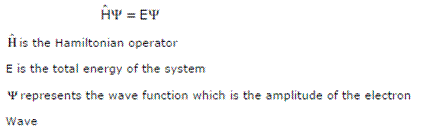
Quantum mechanics is based on a fundamental equation which is called Schrodinger equation.
Here E is actually the quantised value of energy which an electron in an atom has and psi represent the wave function.
Physical significance of wavefunction:
Probability density : ψ gives us the amplitude of wave. The value of ψ has no physical significance. Ψ2 gives us the region in which the probability of finding an electron is maximum. It is called probability density.
Orbital: The region of space around the nucleus where the probability of finding an electron is maximum is called an orbital.
Features of quantum mechanical model:
- The energy of an electron is quantized i.e. an electron can only have certain specific values of energy.
- The quantized energy of an electron is the allowed solution of the Schrödinger wave equation and it is the result of wave like properties of electron.
- probability of finding an electron at a position can be determined and it is |ψ|2 at that point where ψ represents the wave-function of that electron.
- An atomic orbital is the wave-function (ψ) of an electron in an atom. All the information about the electron in an atom is stored in its orbital wave function ψ and quantum mechanics makes it possible to extract this information out of ψ.
- The probability of finding an electron at a point within an atom is proportional to the square of the orbital wave function i.e., | ψ |2 at that point. | ψ |2 is known as probability density and is always positive.
Quantum numbers:
There are a set of four quantum numbers which specify the energy, size, shape and orientation of an orbital.
(i) Principal quantum number (n):
- It identifies shell, determines sizes and energy of orbitals.
n
|
1
|
2
|
3
|
4
|
Shell
|
K
|
L
|
M
|
N
|
Total number of orbitals in a shell = n2
|
1
|
4
|
9
|
16
|
Maximum number of electrons in a shell = 2n2
|
2
|
8
|
18
|
32
|
(ii) Azimuthal quantum number (l):
- It is also known as orbital angular momentum or subsidiary quantum number.
- It identifies sub-shell, determines the shape of orbitals, energy of orbitals and orbital angular momentum of an electron, which is given as,
- The number of orbitals in a subshell = 2l + 1.
- For a given value of n, l can have n values ranging from 0 to n – 1, that is, for a given value of n, the possible value of l are : l = 0, 1, 2, .......... (n–1)
n
|
l
|
Subshell Notation
|
n
|
l
|
Subshell Notation
|
1
|
0
|
1s
|
4
|
0
|
4s
|
2
|
0
|
2s
|
4
|
1
|
4p
|
2
|
1
|
2p
|
4
|
2
|
4d
|
3
|
0
|
3s
|
4
|
3
|
4f
|
3
|
1
|
3p
| |||
3
|
2
|
3d
|
(iii) Magnetic quantum number (ml):
- It is also known as magnetic orbital quantum number.
- It gives information about the spatial orientation of the orbital.
- Number of orbitals in each subshell = 2l+1. i.e., for each value of l, ml = – l, – (l –1), – (l–2)... 0,1...(l – 2), (l–1), l
(iv) Electron spin quantum number (ms):
- It refers to orientation of the spin of the electron.
- It can have two values +1/2 and −1/2. +1/2 identifies the clockwisespin and −1/2 identifies the anti- clockwise spin
THATS ALL FOR THE DAY.
MARK YOUR ATTENDANCE IN FORM AS WELL AS COMMENT SECTION OF BLOG.
Utkrist Gupta
ReplyDelete11-D
present
Aarmaan chhibber
ReplyDelete11D
Present
Anshuman jaison of 11D is presnt
ReplyDeleteAaron Isaac Khakha
ReplyDelete11D
Present
good morning ma'am
ReplyDeletesami ansari 11-D
present
Jaskeerat Singh (11-D) - Present
ReplyDeleteTANUJ PANT
ReplyDelete11 D
PRESENT
Good morning ma'am
ReplyDeleteAnugrah Singh 11D
Present
Good morning ma'am,
ReplyDeleteCelestine Saji,
Present
Good morning ma'am!
ReplyDeleteSHAMBHAVA S. 11D
PRESENT
Good morning ma'am,
ReplyDeleteYumn Jame 11th D present
GOOD MORNING MA'AM
ReplyDeleteTEGHVEER SINGH 11-D
PRESENT
Siddharth Karnish. 11-D
ReplyDelete(Present)
Good Morning ma'am
ReplyDeleteArtham Pedneker 11-D
Present
Good Morning Ma'am
ReplyDeleteSoham Kulkarni 11-D
Attendance form submitted
Good morning ma'am
ReplyDeleteSamarth Jain
11 D
Present
Albin Chandi 11 D present
ReplyDeleteGoodmorning ma'am
ReplyDeleteRahul Bandhu
11D
Good Morning Ma'am
ReplyDeleteRatnango Ghosh
11 D Present
Good morning ma'am
ReplyDeleteYashas Yadav
11-D
Present
Good morning ma'am
ReplyDeleteSarvesh kumar
11-D
Present
Good morning Ma'am
ReplyDeleteSatwik Shrey 11 -D
Present
GOOD MORNING MA'AM
ReplyDeleteRISHIT GUPTA 11-D PRESENT